
Understanding the NCP Product Schedule and EPA Oil Spill Response Product Listings
A technical overview of the EPA National Contingency Plan Product Schedule, surface washing agents, mechanical recovery, waste minimization, and PES-51 documentation.
Understanding EPA Oil Spill Response Product Listings
Oil spills affecting shorelines, industrial facilities, transportation infrastructure, and marine environments often require more than mechanical recovery alone. As petroleum weathers, it can become strongly adhered to rock, concrete, steel, vegetation, and other surfaces, making removal increasingly difficult while increasing the volume of contaminated waste generated during cleanup operations.
For these situations, responders may evaluate specialized oil spill response products designed to support the removal, recovery, treatment, or control of petroleum contamination. Surface washing agents are one category of these products. They are intended to release petroleum from contaminated surfaces so that the released oil can be collected using conventional response techniques such as skimmers, vacuum systems, absorbent materials, and other mechanical recovery methods.
In the United States, chemical and biological agents intended for oil spill response are addressed under Subpart J of the National Oil and Hazardous Substances Pollution Contingency Plan. The U.S. Environmental Protection Agency maintains the National Contingency Plan Product Schedule as a public reference for products that have been submitted under the applicable data and testing requirements for their product categories.
The purpose of the Product Schedule is to provide response agencies with technical information about products that may be considered during oil spill response. Inclusion on the Product Schedule does not constitute EPA approval, certification, endorsement, or a recommendation for use. During an actual incident, decisions regarding whether a listed product is appropriate are made by the Federal On-Scene Coordinator, in consultation with the Unified Command and other responding agencies, based on site-specific conditions, applicable response plans, and environmental considerations.
The National Contingency Plan Product Schedule
The National Contingency Plan Product Schedule is maintained by EPA as part of the federal framework for preparing for and responding to oil discharges and hazardous substance releases in the United States. The Product Schedule identifies commercial products that have been submitted to EPA for review under testing and information requirements established for specific oil spill response product categories.
Information published through the Product Schedule and the associated Technical Notebook is intended to assist Federal On-Scene Coordinators, state agencies, Tribal governments, response contractors, and other organizations involved in oil spill planning and response. The information may include product use conditions, handling precautions, recommended application procedures, physical properties, and toxicity or effectiveness data submitted as part of the product listing process.
Products listed on the NCP Product Schedule are grouped according to their intended function. Product categories include dispersants, surface washing agents, bioremediation agents, solidifiers, and herding agents. Each category serves a different operational role and is subject to category-specific data and testing requirements.
Oil Spill Response Product Categories
EPA Product Schedule → Dispersants • Surface Washing Agents • Bioremediation Agents • Solidifiers • Herding Agents
These categories are not interchangeable. Product selection depends on the response objective, affected environment, characteristics of the oil, available recovery equipment, and authorization by response officials.
Publication on the Product Schedule should not be interpreted as a determination that a product is appropriate for every spill scenario. Product selection depends on numerous operational and environmental factors, including the characteristics of the spilled petroleum, the affected environment, recovery objectives, applicable Area Contingency Plans, and the judgment of the Federal On-Scene Coordinator and Unified Command responsible for managing the response.
Surface Washing Agents
Surface washing agents are formulated to assist in the removal of petroleum from contaminated solid surfaces by reducing the adhesion between oil and the underlying substrate. Rather than chemically altering the petroleum, these products are intended to release it from surfaces such as rock, concrete, steel, vegetation, riprap, pilings, and other shoreline or industrial materials so it can be recovered using conventional response methods.
As petroleum weathers, it becomes increasingly difficult to remove. Evaporation of lighter components, increased viscosity, and prolonged exposure to environmental conditions can cause oil to penetrate porous materials or adhere tightly to solid surfaces. In these situations, mechanical recovery alone may be insufficient to achieve cleanup objectives without extensive excavation, high-pressure washing, or removal of contaminated materials.
Surface washing agents may be considered where responders seek to improve the separation of petroleum from contaminated surfaces while supporting subsequent mechanical recovery. Depending on site conditions and the selected cleanup strategy, released petroleum may be collected using skimmers, vacuum systems, sorbent materials, or other approved recovery techniques. The objective is to recover and remove the released petroleum rather than simply transfer contamination from one location to another.
Because surface washing agents serve a different operational purpose than other oil spill response products, they are evaluated as a separate category on the EPA National Contingency Plan Product Schedule. Their intended role is distinct from products designed to disperse oil into the water column or to enhance biological degradation, and their use is evaluated within the context of the overall response strategy established for each incident.
Surface Washing Agents Compared with Dispersants
Surface washing agents and dispersants are distinct categories of oil spill response products under the EPA National Contingency Plan Product Schedule. Although both may be considered during oil spill response, they are intended to support different response objectives and are evaluated under separate testing requirements.
Surface washing agents are intended to release petroleum from contaminated surfaces so that it can be recovered using mechanical methods. Dispersants are intended to promote the formation of small oil droplets within the water column under approved response conditions. Because these products perform different functions, they are evaluated separately and are subject to different operational considerations.
| Characteristic | Surface Washing Agents | Dispersants |
|---|---|---|
| Primary objective | Release petroleum from contaminated surfaces for subsequent mechanical recovery | Break floating oil into small droplets within the water column |
| Typical application | Shorelines, equipment, vessels, tanks, pavement, and other contaminated surfaces | Primarily offshore or open-water response |
| Recovery objective | Facilitate collection of released petroleum using mechanical recovery methods | Promote dispersion within the water column where approved |
| Typical recovery methods | Vacuum systems, skimmers, sorbents, containment, and oil-water separation | Mechanical recovery is generally not the primary objective after application |
| Waste minimization | May reduce contaminated solids and wastewater when used appropriately | Not intended as a waste minimization technology |
| EPA Product Schedule | Separate product category with distinct testing requirements | Separate product category with distinct testing requirements |
How Surface Washing Agents Support Mechanical Recovery
Oil spill response is often a balance between effective contaminant removal and minimizing the environmental impacts associated with cleanup activities. In many shoreline and industrial cleanup operations, a significant portion of the total project cost is not the treatment step alone, but the handling, transportation, treatment, and disposal of contaminated materials generated during the response.
Where appropriate, surface washing agents may support cleanup objectives by releasing petroleum from contaminated surfaces so that the oil can be recovered using mechanical methods. Recovering petroleum while leaving the underlying material in place can reduce the volume of contaminated waste requiring off-site management, particularly where excavation or replacement of otherwise serviceable materials would be the alternative.
Depending on site conditions and the selected response strategy, recovered petroleum may be collected using skimmers, vacuum systems, sorbent materials, or other approved recovery techniques. A reduction in contaminated solids and wastewater can simplify waste management and may help offset response costs by reducing the volume of material requiring transportation, treatment, and disposal.
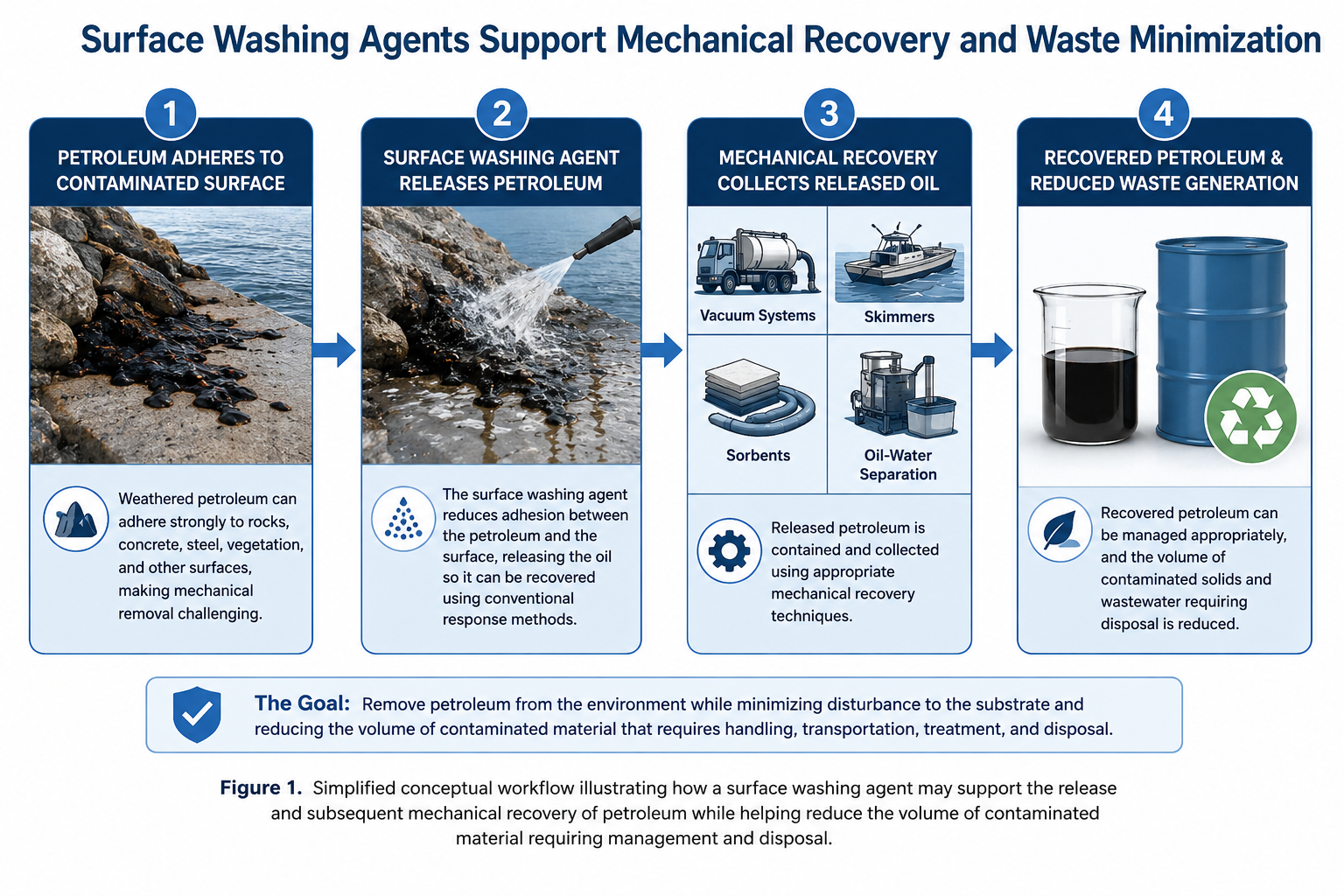
Mechanical Recovery Workflow
Contaminated surface → surface washing agent application → petroleum released from substrate → containment, vacuum recovery, skimming, sorbent collection, or oil-water separation → recovered petroleum → reduced contaminated waste requiring disposal.
The potential benefits of waste minimization extend beyond disposal costs. Reducing the quantity of contaminated material requiring handling can shorten cleanup operations, reduce equipment and transportation requirements, preserve existing infrastructure where practical, and decrease the environmental footprint associated with waste processing and disposal. The suitability of any response approach, however, depends on site-specific conditions, regulatory requirements, and the objectives established for the incident.
EPA Evaluation and Product Listing
Products included on the National Contingency Plan Product Schedule are submitted to EPA for evaluation in accordance with the testing and information requirements established for their respective product categories. The required data are intended to provide response agencies with standardized technical information that can be considered during oil spill planning and response.
For each product category, EPA specifies the testing protocols, product information, and supporting documentation that must accompany a submission. Because surface washing agents, dispersants, bioremediation agents, and other oil spill response technologies serve different operational purposes, each category is evaluated under its own requirements.
Following review of a complete submission, EPA publishes qualifying products on the National Contingency Plan Product Schedule along with technical information provided as part of the submission. The Product Schedule serves as a publicly available reference for Federal On-Scene Coordinators, state agencies, Tribal governments, and other organizations involved in oil spill preparedness and response.
Publication on the Product Schedule should not be interpreted as a recommendation that a listed product be used during every spill response. The decision to authorize the use of any response product depends on numerous factors, including the type and condition of the spilled petroleum, the affected environment, applicable Area Contingency Plans, environmental tradeoffs, and the cleanup objectives established by the Unified Command.
PES-51 and the EPA NCP Product Schedule
EPA maintains a technical product summary for PES-51 in the National Contingency Plan Product Schedule Technical Notebook. The EPA technical summary identifies Practical Environmental Solutions, formerly known as Petroleum Environmental Services, as the manufacturer and describes recommended application procedures for shoreline and surface treatment, tank cleaning, and equipment decontamination.
The EPA technical summary describes application methods including handheld spraying, airless spraying, pressure washer feed systems, modified air knife application, boat spraying, aerial spraying, and vehicular spraying. The appropriate application method depends on the extent and type of hydrocarbon contamination, the degree of weathering or emulsification, the surface being treated, equipment availability, logistics, and manpower requirements.
For shoreline cleaning, the EPA technical summary states that treatment areas are to be boomed and contained prior to PES-51 use. For equipment decontamination, portable decontamination pools or secondary containment liners are recommended. These procedures reflect the central recovery objective of the product: released hydrocarbons should be contained and collected rather than allowed to migrate uncontrolled.
EPA’s current public materials should be reviewed before making any regulatory representation about PES-51 classification or availability, because EPA revised Subpart J listing requirements and transition deadlines in 2023–2026. Current authorization for use during an oil discharge remains subject to Subpart J and the Federal On-Scene Coordinator.
Documented Field Applications
Selection of an oil spill response product depends on site-specific conditions, regulatory requirements, and operational objectives. For that reason, documented field applications provide valuable context beyond laboratory testing by illustrating how response technologies have been incorporated into real-world cleanup projects.
Published reports describing the use of PES-51 span a range of environmental conditions and cleanup objectives, including shoreline restoration following major marine oil spills, treatment of weathered residual petroleum, equipment decontamination, and waste minimization during recovery operations. These reports were prepared by government agencies, research organizations, and response contractors and document project-specific methodologies, observations, and results.
Deepwater Horizon Shoreline Treatment
Published treatment evaluations documented the use of surface treatment methods for weathered crude oil in northern Barataria Bay, Louisiana salt marshes following the Deepwater Horizon spill.
Prince William Sound Residual Oil Recovery
Residual oil studies following the Exxon Valdez spill evaluated treatment approaches for oil embedded in shoreline sediments and gravel environments in Prince William Sound.
Equipment Decontamination and Waste Minimization
Equipment decontamination applications focus on releasing hydrocarbons from response equipment, vessels, hoses, tanks, and contaminated infrastructure while maintaining containment and recovery of released oil.
Each project addressed different cleanup challenges, but together they demonstrate the range of environments in which oil release and surface treatment approaches have been evaluated as part of an integrated mechanical recovery strategy.
Selecting the Appropriate Oil Spill Response Technology
Successful oil spill response rarely depends on a single cleanup technology. Mechanical recovery, sorbents, excavation, flushing, bioremediation, dispersants, surface washing agents, and other response techniques each serve specific roles depending on the characteristics of the spilled petroleum, the affected environment, regulatory requirements, and the objectives established for the incident.
Surface washing agents are generally considered when petroleum has adhered to solid surfaces and responders seek to improve mechanical recovery while minimizing disturbance to the underlying substrate. They are most effective when incorporated into a planned recovery operation that includes collection of the released petroleum using appropriate mechanical methods.
Selection of any response product requires consideration of numerous site-specific factors, including:
- Type and weathering of the petroleum
- Surface characteristics and substrate conditions
- Sensitivity of the surrounding environment
- Recovery objectives and cleanup endpoints
- Applicable regulations and response plans
- Available recovery equipment and waste management options
Because every incident presents unique challenges, response strategies are developed using available technical information, regulatory guidance, operational experience, and site-specific assessment. The EPA National Contingency Plan Product Schedule provides one component of that decision-making process by making standardized product information available to response agencies and planners.
Frequently Asked Questions
Does NCP Product Schedule listing mean EPA approves a product?
No. EPA states that listing on the NCP Product Schedule does not mean EPA approves, recommends, licenses, or certifies the product for use on an oil discharge. Listing means that data have been submitted to EPA as required by Subpart J of the National Contingency Plan.
Who authorizes product use during an oil spill response?
Only a Federal On-Scene Coordinator may authorize use of a listed product in accordance with Subpart J during an oil discharge response. Product use is considered within the context of the incident, applicable response plans, environmental tradeoffs, and Unified Command objectives.
How do surface washing agents differ from dispersants?
Surface washing agents are intended to release petroleum from contaminated surfaces so that it can be recovered using mechanical response methods. Dispersants are intended to increase the dispersion of floating oil within the water column under approved response conditions. Because these products serve different response objectives, they are evaluated under separate EPA testing protocols and listed in different categories on the National Contingency Plan Product Schedule.
What happens to petroleum released by a surface washing agent?
Released petroleum should be contained and collected using appropriate recovery methods such as vacuum systems, skimmers, absorbents, containment booms, or other approved techniques. The response objective is recovery and removal rather than uncontrolled transfer of contamination.
References
- U.S. EPA. National Contingency Plan Product Schedule: https://www.epa.gov/emergency-response/alphabetical-list-ncp-product-schedule-products-available-use-during-oil-spill
- U.S. EPA. National Contingency Plan Subpart J: https://www.epa.gov/emergency-response/national-contingency-plan-subpart-j
- U.S. EPA. PES-51 National Contingency Plan Product Schedule Technical Summary: https://www.epa.gov/emergency-response/pes-51-national-contingency-plan-product-schedule
- 40 CFR Part 300, Subpart J: https://www.ecfr.gov/current/title-40/chapter-I/subchapter-J/part-300/subpart-J
Technical Documentation and Application Guidance
Practical Environmental Solutions can provide PES-51 product documentation, technical background, and application guidance for shoreline restoration, equipment decontamination, industrial cleaning, residual oil recovery, and waste minimization projects.