
Deepwater Horizon Shoreline Treatment Research
A technical review of published shoreline cleaner research conducted following the Deepwater Horizon oil spill, including documented evaluation of PES-51, lift-and-float surface washing agents, mechanical recovery, and waste minimization considerations.
The Deepwater Horizon Response and Shoreline Cleanup Challenges
The Deepwater Horizon oil spill created one of the largest and most complex oil spill response operations in United States history. Response activities extended across offshore waters, barrier islands, marshes, beaches, ports, vessels, and shoreline infrastructure throughout the Gulf Coast.
As the response progressed, a significant portion of the remaining petroleum became weathered through evaporation, emulsification, and prolonged environmental exposure. Unlike fresh oil that can often be recovered from the water surface, weathered petroleum may adhere to vegetation, sediments, riprap, concrete, steel, and other substrates where mechanical recovery alone becomes increasingly difficult.
Shoreline response therefore required a wide range of cleanup strategies selected according to location, environmental sensitivity, oiling conditions, and cleanup objectives. Offshore operations emphasized containment and recovery, while shoreline operations focused on removing adhered petroleum while minimizing unnecessary disturbance to marsh vegetation, sediments, and other sensitive coastal environments.
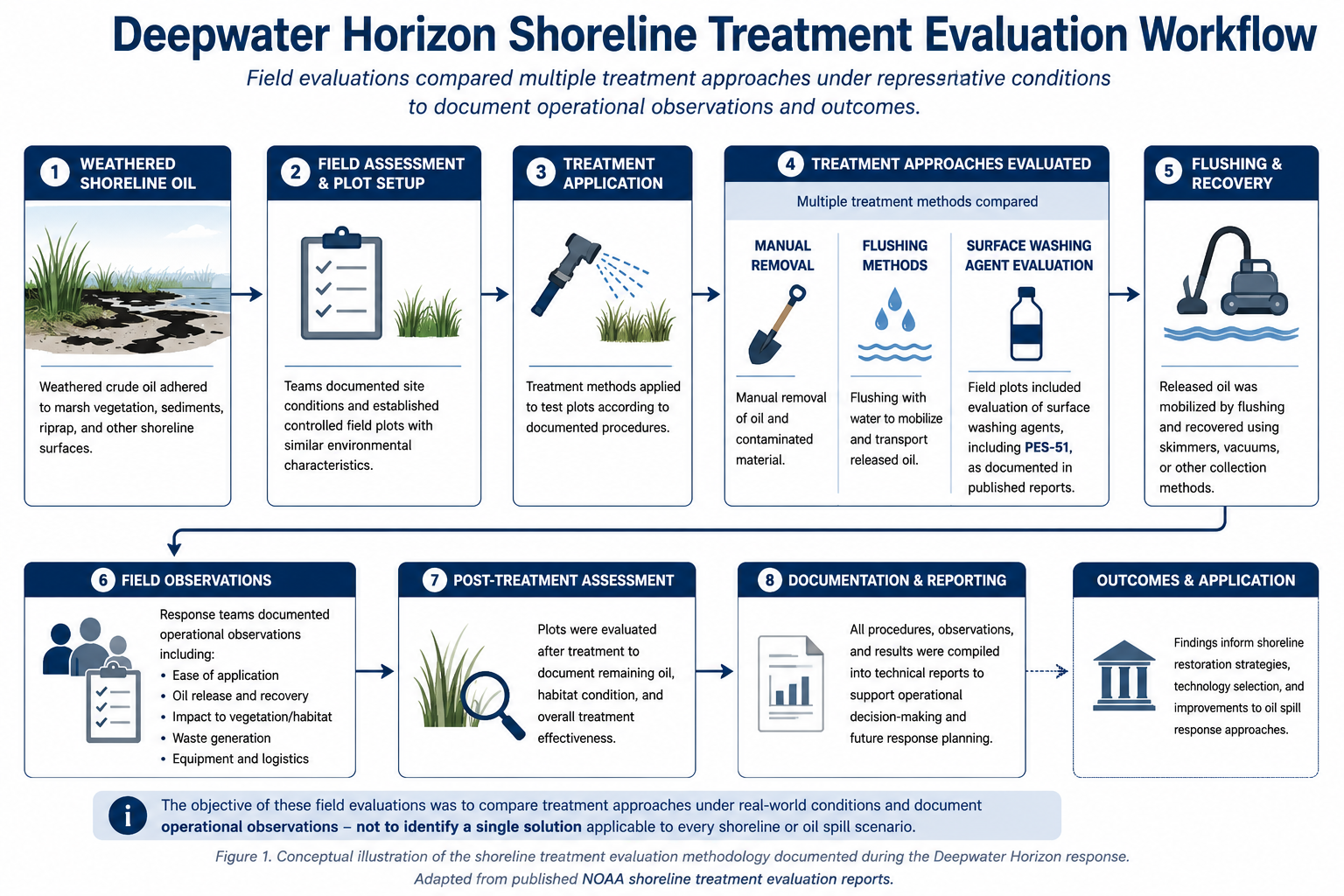
Because no single cleanup method was appropriate for every situation, agencies, researchers, and response organizations evaluated multiple treatment approaches during and after the response. These evaluations included mechanical recovery techniques, manual removal, flushing methods, and surface treatment technologies intended to improve the release and recovery of weathered petroleum under specific site conditions.
Evaluating Shoreline Treatment Technologies
Following the initial emergency response, agencies responsible for shoreline assessment and cleanup recognized that weathered petroleum presented challenges beyond those encountered during open-water recovery operations. Oil had become incorporated into marsh vegetation, accumulated along tidal shorelines, adhered to hard surfaces, and penetrated sediments where conventional recovery techniques alone were often insufficient.
To better understand available response options, treatment evaluations were conducted under field and laboratory conditions representative of salt marsh and shoreline environments. Rather than relying on a single cleanup technique, investigators examined multiple approaches designed to release, recover, or remove weathered petroleum while minimizing unnecessary disturbance to sensitive habitats.
The objective of these evaluations was not to identify a universal solution, but to better understand how different treatment methods performed under specific environmental conditions. Factors such as oil weathering, vegetation density, substrate type, tidal influence, recovery logistics, and waste generation all influenced the suitability of a given treatment strategy.
These published evaluations continue to provide useful technical information for environmental professionals involved in shoreline restoration, equipment decontamination, and planning for future oil spill response operations.
Published Evaluation of Surface Washing Agents
Among the treatment methods evaluated following the Deepwater Horizon response were shoreline cleaners, also referred to as surface washing agents. These products are intended to assist in removing oil from substrates such as shorelines, seawalls, vegetation, riprap, or other contaminated surfaces.
NOAA Technical Memorandum NOS NCCOS 232, Efficacy and Ecotoxicological Effects of Shoreline Cleaners in Salt Marsh Ecosystems, evaluated three shoreline cleaner products: PES-51, CytoSol, and Accell Clean SWA. The report assessed toxicity, petroleum hydrocarbon distributions in water and sediment, and oil-removal efficiency from artificial substrates using Louisiana Sweet Crude oil.
The report describes shoreline cleaning agents as products that may release stranded oil from shoreline substrates. Once released, the operational goal may be to mechanically recover the removed oil, depending on product behavior, site conditions, and response objectives.
The NOAA publication also distinguishes between “lift and disperse” and “lift and float” surface washing agents. It identifies PES-51 as a “lift and float” surface washing agent, a category intended to release oil without dispersing it so that the oil can form surface slicks that are recoverable under appropriate conditions.
PES-51 in the NOAA Shoreline Cleaner Evaluation
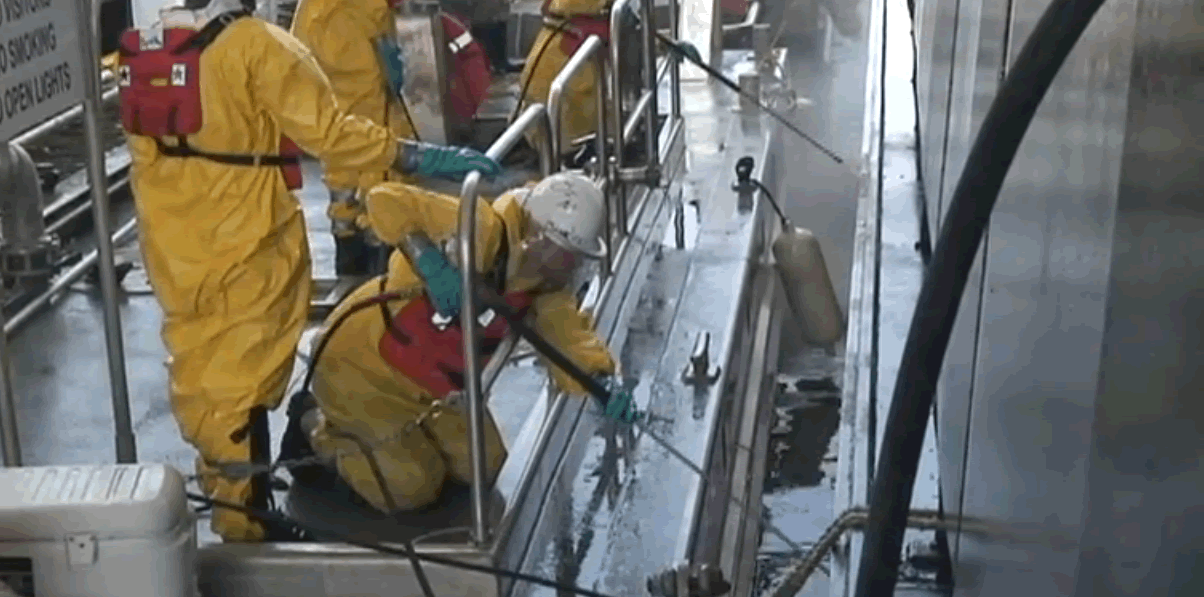
The NOAA technical memorandum includes a dedicated product background section for PES-51. The report identifies PES-51 as manufactured by Practical Environmental Solutions, formerly known as Petroleum Environmental Services, and describes it as a biodegradable surface-washing agent used for shoreline and surface treatment, tank cleaning, and equipment decontamination.
The report describes manufacturer-recommended use of PES-51 at full strength, with application by hand sprayer, a short soak period, and rinsing followed by recovery with adsorbents. It also notes that the manufacturer reports the product/oil mixture has a density less than one, allowing it to float until it can be absorbed, skimmed, or vacuumed.
Of particular technical importance, the report states that the manufacturer reports a temporary protein film remains after treatment on the water surface that prevents mobilized oil from re-depositing. The report also describes PES-51 as consisting primarily of d-limonene and bacterial fermentation by-products that, in combination with the carrier solvent, form a biological mixture that surrounds hydrocarbon molecules and lifts them from surfaces.
These statements are valuable because they connect the operational concept of PES-51 to the broader recovery objective emphasized throughout the Technical Resources library: release petroleum from contaminated surfaces, keep the mobilized oil recoverable where conditions allow, and support containment, skimming, vacuum recovery, sorbent collection, or other mechanical recovery methods.
Why Published Field and Laboratory Evaluations Matter
Laboratory and mesocosm testing provide valuable information about product characteristics under controlled conditions, but large-scale oil spill response presents environmental and operational variables that cannot be fully replicated in a laboratory. Shoreline type, petroleum weathering, tidal influence, vegetation, equipment availability, recovery logistics, and cleanup objectives all influence how a treatment strategy performs in practice.
For that reason, documented evaluations conducted in response to major oil spills provide an important source of technical information for environmental professionals. They illustrate how treatment technologies were selected for study, describe the observations made by researchers, and document the practical considerations associated with different cleanup approaches.
The Deepwater Horizon-related shoreline cleaner evaluations remain useful because they examine both performance and ecological considerations. For environmental consultants, spill response organizations, and regulatory agencies, that combination is often more useful than isolated product descriptions alone.
Technical Observations
The published research demonstrates several principles that remain relevant to shoreline restoration and hydrocarbon remediation projects:
- Weathered petroleum behaves differently than freshly spilled oil and may adhere strongly to vegetation, rock, sediment, concrete, steel, and other substrates.
- Successful shoreline restoration frequently requires multiple treatment methods working together rather than reliance on a single technology.
- Surface treatment technologies are most relevant when incorporated into an overall response strategy that includes containment and collection of released petroleum where practical.
- Selection of treatment methods depends on site-specific environmental conditions, regulatory requirements, cleanup objectives, and operational constraints rather than a single standardized procedure.
- Product performance, toxicity, oil-removal behavior, and recovery logistics all matter when evaluating oil spill response technologies.
These observations reinforce the importance of evaluating remediation technologies within the context of an integrated response plan rather than viewing individual products as stand-alone solutions.
Mechanical Recovery and Waste Minimization
The most important practical distinction for many oil spill response professionals is not simply whether a product can release oil from a surface, but whether the released petroleum can be contained and recovered. Products that support recovery may help reduce the amount of contaminated debris, wash water, or otherwise serviceable material requiring transportation, treatment, and disposal.
PES-51 is described in the NOAA technical memorandum as a lift-and-float surface washing agent. In appropriate response settings, this mode of action aligns with a mechanical recovery strategy because released petroleum is intended to remain recoverable through containment, skimming, vacuum recovery, sorbents, or related response techniques.
Waste minimization does not mean eliminating waste from a response operation. Rather, it means reducing avoidable waste generation where practical by recovering petroleum while preserving underlying surfaces, equipment, infrastructure, or shoreline materials when site conditions and response objectives allow.
Lasting Significance
More than a decade after the Deepwater Horizon response, published shoreline cleaner research continues to serve as a technical reference for environmental consultants, spill response organizations, regulatory agencies, and researchers studying shoreline remediation methods.
The continuing value of these publications lies not only in individual treatment observations, but also in the systematic approach used to compare products under documented test conditions. For organizations responsible for planning future response activities, the research helps illustrate both the potential role and the limitations of shoreline treatment technologies.
For PES-51 specifically, the NOAA technical memorandum provides third-party documentation of product background, reported mechanism, lift-and-float classification, and oil-removal evaluation in the context of Deepwater Horizon-related shoreline cleaner research.
Related Technical Resources
Understanding EPA Oil Spill Response Product Listings
Learn how the National Contingency Plan Product Schedule supports evaluation of oil spill response technologies and the role of surface washing agents within the federal response framework.
Equipment Decontamination
Explore applications of PES-51 for cleaning vessels, containment boom, skimmers, hoses, tanks, and other oil spill response equipment while supporting hydrocarbon recovery.
Prince William Sound Residual Oil Recovery
Review published studies describing treatment of weathered petroleum remaining along Alaska shorelines following the Exxon Valdez oil spill.
Case Study Library
Browse documented field applications and published technical reports supporting the use of Practical Environmental Solutions remediation technologies.
Frequently Asked Questions
Was PES-51 evaluated in Deepwater Horizon-related shoreline cleaner research?
Yes. NOAA Technical Memorandum NOS NCCOS 232 identifies PES-51 as one of three shoreline cleaner products evaluated in salt marsh ecosystem testing related to oil spill response research following Deepwater Horizon.
Was the NOAA report an endorsement of PES-51?
No. The report includes a disclaimer stating that the NOAA publication does not constitute an endorsement of any commercial product and should not be used to imply that NOAA recommends or endorses a proprietary product.
What does “lift and float” mean?
In the NOAA report, lift-and-float products are described as cleaners that lift oil without dispersing it, allowing oil to form surface slicks that can be recovered under appropriate response conditions. PES-51 is identified in the report as a lift-and-float surface washing agent.
Why does mechanical recovery matter?
Mechanical recovery focuses on collecting released petroleum whenever practical rather than allowing contamination to remain in the environment or creating unnecessary volumes of contaminated waste requiring disposal.
Where can the original research be reviewed?
The NOAA technical memorandum is publicly available through the NOAA Institutional Repository under the title Efficacy and Ecotoxicological Effects of Shoreline Cleaners in Salt Marsh Ecosystems.
References
- NOAA Technical Memorandum NOS NCCOS 232. Efficacy and Ecotoxicological Effects of Shoreline Cleaners in Salt Marsh Ecosystems. https://repository.library.noaa.gov/view/noaa/16082/noaa_16082_DS1.pdf
- U.S. Environmental Protection Agency. National Contingency Plan Product Schedule. https://www.epa.gov/emergency-response/alphabetical-list-ncp-product-schedule-products-available-use-during-oil-spill
- U.S. Environmental Protection Agency. PES-51 National Contingency Plan Product Schedule Technical Summary. https://www.epa.gov/emergency-response/pes-51-national-contingency-plan-product-schedule
- 40 CFR Part 300, Subpart J. https://www.ecfr.gov/current/title-40/chapter-I/subchapter-J/part-300/subpart-J
Additional Technical Information
Practical Environmental Solutions maintains technical documentation, published research summaries, and field application references supporting shoreline restoration, equipment decontamination, hydrocarbon recovery, and waste minimization.